Easy Immune Gummies – Elder, One Plant, Many Uses

Cassandra Duffill
Naturopath | Health Haven

Easy Immune Gummies – Elder, One Plant, Many Uses

by

If you’ve ever wondered whether you should see a naturopath or your GP, you’re not alone. It can be hard working out the right way forward, so this article was created to help you find some clarity.

The two approaches are often positioned as though they’re competing teams: conventional medicine on one side, natural medicine on the other.  Over the years I’ve seen many people put their stake in the ground, and refused to look at the other.  I believe the reality is far less dramatic, and has to align with what is best for the patient or client.

Conventional medicine and naturopathic care come from different perspectives and look at health through a different lens.  Each has strengths, limitations and situations where it may be particularly useful. For example, if I break my wrist I’m going straight to the ER for plaster, not to my herb cupboard.  

The key is understanding that the choice may not be one or the other, but which suits you best in a certain situation and how to use each to your advantage.

I’m well known for saying I don’t bump around my house in the dark, refusing to turn on a light because it’s a modern invention. So I don’t believe we have to one-eyed on either side.  The best approach is knowing how each can help you so you can work out what you need and when, and blending the best of both worlds.

Conventional Medicine – diagnosis, treatment and acute care

Conventional medicine is the healthcare most of us are familiar with. You might see your GP when something feels wrong, have pathology or imaging performed, receive a diagnosis, be prescribed medication, be referred to a specialist or undergo a procedure when necessary.  Its strengths are particularly clear when something requires urgent investigation or intervention.

If you break a bone, develop a serious infection, experience severe chest pain or need surgery, you want conventional medical care. There is no herbal tea on earth that should be trying to compete with an emergency department. 

Where people can become frustrated is when they have persistent symptoms without a straightforward diagnosis, or when treatment manages the condition but they still don’t feel particularly well. I know that was my personal experience and the entire reason I sought a naturopath in the first place.

They might hear: “Your blood tests are normal.” “Everything looks fine.”  “It’s probably IBS.” “Just keep taking the medication.”

And yet they’re still tired, bloated, uncomfortable, struggling with food, sleeping badly or feeling as though their body simply isn’t functioning the way it used to. That’s often when people start looking for answers and support elsewhere. I know I did. When my GP told me my digestive issues were my “new normal” and I just had to “get used to it”, that’s when I started the search for help outside conventional medicine.

Naturopathy – what does it do and where does it fit?

Naturopathic care generally takes a broader look at the person sitting in front of us. Rather than focusing solely on an individual symptom, we spend time exploring the pattern around it. That may include things such as: digestive function, food intake and nutrition, sleep, stress and lifestyle, menstrual and hormonal patterns, medications and supplements, pathology results, previous illness or infections, family and health history, energy levels, bowel habits, the timeline of when symptoms began and what was happening around that time

The question isn’t simply: “What symptom do you have?”. It is broader. We ask “what else is happening, how do the peices fit together, and what’s exacerbating it?”

Where a standard doctor’s consult gives you 10mins of rushed discussion, a naturopathic initial consultation gives you an hour a more (90mins at Health Haven) to share your health concerns in detail. The longer consultations naturopaths provide are particularly useful when someone has several symptoms, interconnection issues or has been dealing with a health issue for a long time.

A naturopathic consultation allows the time for us to delve into the issues and understand what’s happening.

Naturopathy is not just “taking something natural instead”

This is an important distinction, as many people think the difference is naturopaths just give supplements and herbs instead of pharmaceuticals. But it’s so much more.

The aim is to understand what support may be appropriate for the individual and to use treatment thoughtfully.

Depending on the person, naturopathic treatment may include nutrition, lifestyle changes, herbal medicine, nutritional supplementation and other supportive strategies.

Sometimes the most useful recommendation is actually simplifying what someone is already doing.

Because taking an entire kitchen cupboard of supplements isn’t automatically more holistic.

Naturopathic consutlations, the key differences

One of the most noticeable differences for clients is usually time and the depth of consultation. The duration allows us to spend more time understanding what’s going on, and how we can help.

Naturopaths also take the time to understand YOU, what your health goals are, the best options to support you and even what your budget considerations are. At Health Haven we make sure we create a plan that suits your life as well as your budget.

And something we do, that not many naturopaths do, is support you in the time between consultations. Many clinics seem to forget their patients exist between appointments, but we don’t.  From our private client portal where you can message whenever you need, to our check-in calls and the others ways you can contact us if you need us, you are never left wondering what the next steps are.

What About Testing?

There can also be differences in the type and purpose of testing used. Conventional medicine uses pathology, imaging and other investigations to diagnose disease, assess risk and monitor health.

Naturopaths may review those same results alongside a person’s symptoms and history, and in some cases may recommend additional testing where appropriate.

More testing, however, isn’t always better. At Health Haven we only use testing when it’s clinically relevant, will add to our ability to support you, and fits your budget.

Naturopaths at Health Haven can order any pathology you may need, the main difference being that we cannot bulk-bill your tests as doctors can. Many clients bring their results to us that they received from their GP.

 Testing should create clarity, not be an expensive fishing expedition.

Where naturopathic care can be useful

People often seek naturopathic care when they want more support around persistent or complex health concerns. That might include digestive symptoms, fatigue, food-related issues, hormonal concerns or chronic health presentations where several systems appear to be involved.

Others already have a medical diagnosis and simply want additional help with areas such as nutrition, lifestyle, symptom support or general wellbeing alongside their existing medical treatment.

The naturopath’s role isn’t necessarily to replace the medical care already happening. Often it is to work alongside it.

Can you see a naturopath and a doctor at the same time?

Absolutely. Many clients and patients choose to do both. However if you’d prefer to only see a naturopath, that is fine too. Our goal is to work with you for the best outcomes in your health, in whatever ways you feel best.

You might have a GP or specialist managing diagnosis, medications and medical monitoring while a naturopath works with you on nutrition, lifestyle, digestive health, supportive treatment and other aspects of your overall care.

It doesn’t have to be one or the other.

Should you be receiving medical care while working with a naturopath at Health Haven, we are very happy to keep your doctor or specialist in the loop with regular reports and information, should you wish us to.

Our Goal is the Best Care for You

Healthcare becomes much more useful when we stop treating different professions as though they need to compete. There may be times when you need a prescription. There may be times when you need surgery.

There are also times when you need someone to spend an hour looking at the last five years of your health and ask why several seemingly unrelated symptoms may have appeared together.

At Health Haven, our approach is to work within the bigger picture, using naturopathic care to support to you.

If you’ve been dealing with ongoing symptoms, a complex health history or simply feel as though the pieces of your health haven’t quite been connected, a naturopathic consultation can help you take a more detailed look at what’s going on and what your next steps may be.

If it’s time to get help with your health, book a Naturopathic Consultation here. We look forward to supporting you.

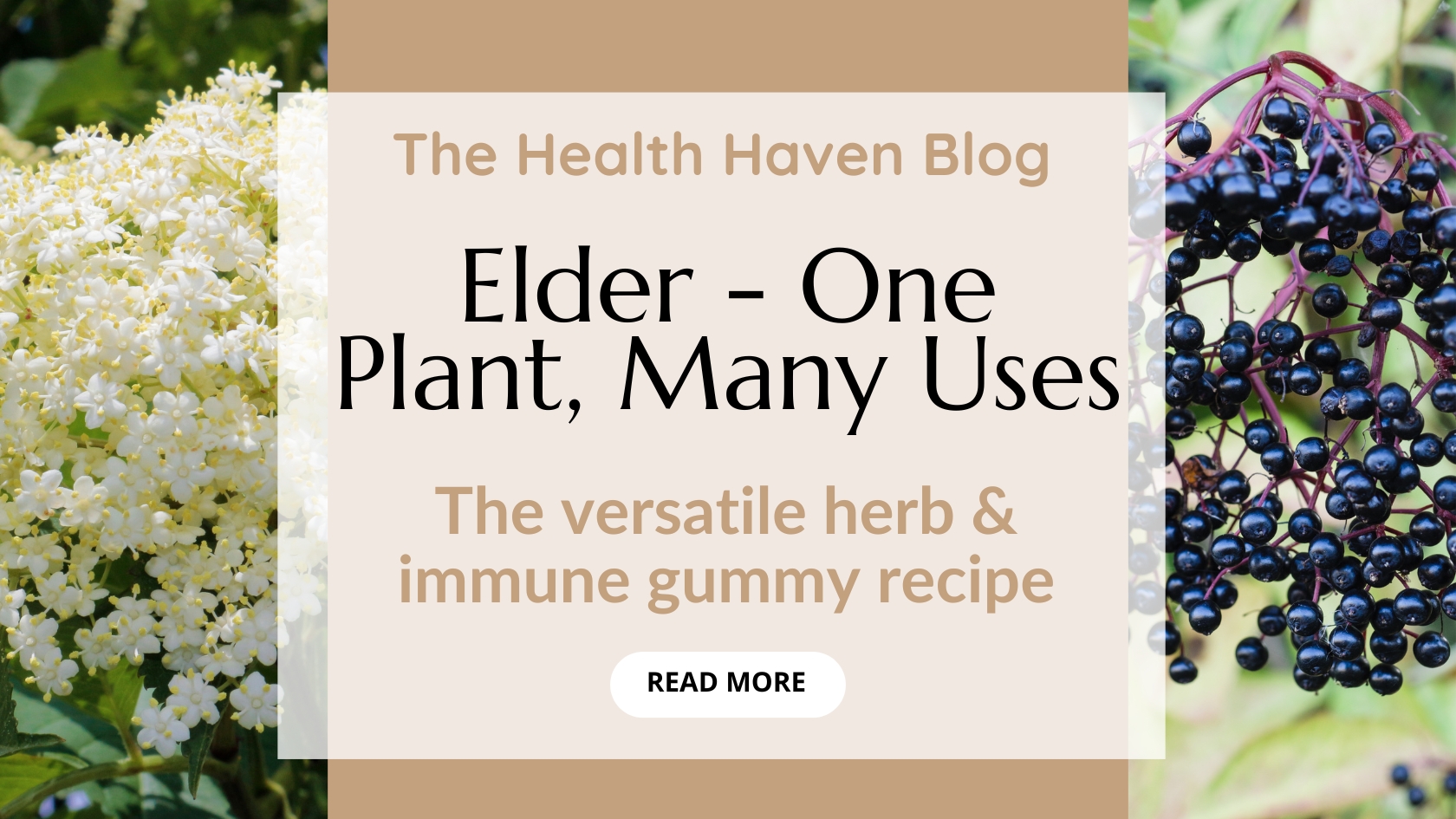
Elder is one of those plants I keep coming back to, not because it is trendy, but because it is genuinely useful. The same plant gives us elderberries and elderflowers, and they each have their own personality. One is deep and grounding, the other is light and uplifting. Together, they are a beautiful example of how versatile herbal medicine can be for everyday family health.

If you are building a simple home medicine cupboard, elder is a great place to start.


Elderberry vs elderflower, what is the difference?


Both come from the elder tree (Sambucus nigra).

Elderberries are the dark purple berries. Traditionally, they are used most for seasonal immune support, especially when you feel run down or when something is going around the household.

Elderflowers are the delicate creamy-white flowers. Traditionally, they are used for upper respiratory support and to help the body move through seasonal congestion. They are also commonly used in teas and syrups because they taste beautiful.

Why is Elder such a staple herb? 

It’s a super practical, easy to grow, everyday herb that is versatile and can be used in many different ways.

It fits real life and is easy to use, as it can be a tincture, tea, gummies, syrup or lozenges.

Gentle and effective, it’s a family favourite. Plus it pairs well with with a wide range of other herbs and nutrients (and the syrup is a great addition to anything you want kids to take readily!). 

How I use Elder in clinic and at home

In clinic, elder is often part of a broader plan. If someone is getting sick repeatedly, we look at the bigger picture, digestion, nutrient status, sleep quality, stress load, and whether the immune system is constantly being asked to do too much.

At home, I like elder for those times when you want something simple and supportive that the whole family can take consistently. 

Elderberry Immune Gummies – Easy Family Recipe

First, make your elderberry syrup

These are a simple way to use elderberry in a form kids and adults will actually take. You can keep them in the fridge for a week, or freeze them for longer storage.

Before you can make the gummies you will need elderberry syrup.  I like to make my own but you can also purchase it.

How To Make Elderberry Syrup:

200g dried elderberries

900ml water

200g sugar or honey (see below, honey or sugar versions)

Place the dried berries and water in a saucepan and gently simmer for 40mins, stirring occassionally.  You may like to mash the berries a bit, with the back of the spoon or potato masher. 

Sugar Version: Put the sugar into a measuring jug (you’ll need to measure up to 1L). Strain the elderberry mixture into the measuring jug, on top of the sugar.  It should be about 700ml. If it’s a little short you can top with water. You may like to squeeze your elderberry mixture through a cheesecloth to make sure you get all the liquid.  Then pour the elderberry mixture with the sugar or honey back into the saucepan and simmer gently for 5 minutes. Remove from heat and let cool a little before bottling for storage.

Honey Version: follow the same steps until you are straining the elderberry mixture. Do not add the honey into the jug, instead ONLY strain the berry mixture.  You should have about 500ml, maybe a little more. If needed, top with water.  Leave in the jug to cool to about 35 degrees celcius, then stir through 200ml honey and mix well.  Pour into bottles for storage.

Note: honey version must be kept in the fridge. With proper sterilisation and bottling, the sugar version may be shelf stable until opened.  Honey is my preferred option for the additional health benefits, however the sugar version is great to always have some onhand. 

Next, let’s make the gummies!

Ingredients:

1 cup elderberry syrup

1/4 cup gelatin powder

1/2 cup hot (not boiling) water

Optional Ingredients:

1 tablespoon vitamin C powder

Rosella herbal tea – steep a strong brew in a cup and allow to cool. Add up to 50ml for an additional vitamin C boost.

Method:

In a bowl add 1/4 cup elderberry syrup. Sprinkle gelatin across the surface (not in a heap) and quickly whisk til it dissolves.

Add the hot water and whisk quickly until smooth.

Add remaining elderberry syrup and whisk quickly until smooth.

If adding vitamin C powder or Rosella tea, co so now and whisk till smooth.

Use small silocone moulds and align them on a baking tray so they can firm up while completely flat.  Add the elderberry mixture to each mould. Refridgerate 1 to 2 hours, or until firm.

Pop out of moulds an store in an airtight container. Use patchment paper between layers to prevent sticking. Some people like to dust them lightly with cornflour or castor sugar, however I just use baking paper.

Storage: these will store in the fridge for up to 3 weeks. Freeze in an airtight container for 6-12 months. Sugar based syrup gummies have a longer life than honey based.

A gentle word of warning

Just because a herb is natural, that doesn’t mean it suits everyone. You can still be allergic to a natural herb.

Elder specifically has a few simple warnings to follow, to ensure you’re creating safe medicines.

Firstly, the raw berries (particularly unripe berries) should not be consumed. Use only fully ripe berries and cook them before use.

Don’t use the leaves, bark or stems to make medicines as they are toxic. They contain compounds that can be toxic.  Only use the flowers and ripe berries and cook them before use.

If you’re pregnant, breastfeeding, on immune modulating medications or have allergy to elder, do not use this herb without professional advice.


0 Comments

Submit a Comment

Your email address will not be published. Required fields are marked *

YOU MIGHT ALSO ENJOY

Why Stress is Rarely Just Stress

Why Stress is Rarely Just Stress

We are all too familiar with the five-letter word: stress. When you're constantly exhausted, irritable, or battling brain fog, the go-to advice is often to "just relax," take a bubble bath, or go on vacation. But as naturopathic practitioners, we look at the bigger...

Chronic Fatigue – how I recovered & what it taught me

Chronic Fatigue – how I recovered & what it taught me

People often joke and say I was the “sickest naturopath they’ve ever met”… but living it was no joke. Long before I became a practitioner, I was the patient. I had to recover my health twice from chronic fatigue, and today I want to share what that was like, and what...

My Health Journey – and why it changed everything

My Health Journey – and why it changed everything

Before I was the practitioner, I was the patient...In my 20’s I had an amazing career and the world looked bright. I’d completed a business & marketing degree and landed roles with some of the most recognisable brands in the world – McDonald’s, Vodafone, Sony...